In May there are interesting exhibitions due to open. By the third week of April, UNISA Art Gallery announced the opening of the exhibition, African ReUnion: A Celebration of Pan-African Imagination and Unity on 14 May. Replacing the poignant retrospective exhibition of Peter E. Clarke titled, For Some the pathway to education lies between thorns. A title taken from one of the works that formed part of two collections that brought together in a comparative art exhibition of the work of Clarke belonging to the William Humphreys Gallery in a quite reflection with the collection of Clarke’s works in the holdings of UNISA Art Gallery.
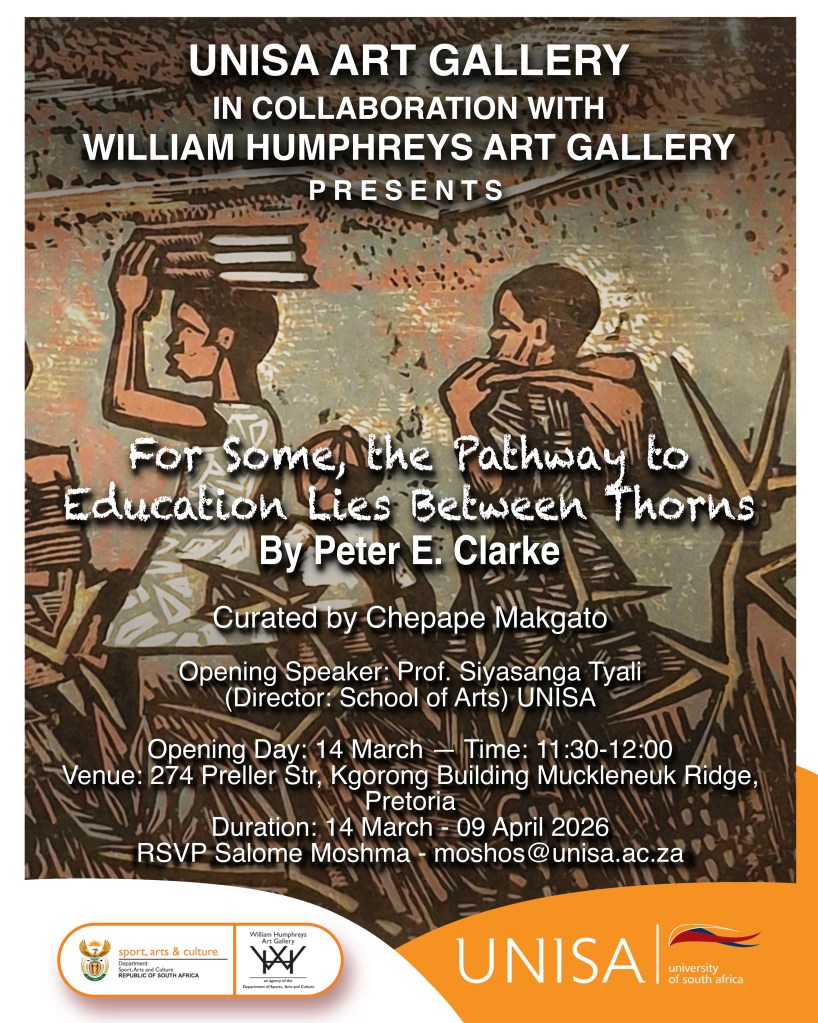
For me there was something special on how the exhibition was relating these two collections in an intertextual conversation through an inclusion of a few works that belonged to the curator of the exhibition, Kehla Chepape Makgatho, in the exhibition. The insertion of the curator through their personal, permit me to use the word, ‘artefacts’ within the conversation erected by the exhibition of the two collections connects him directly to the artist. A key to this opinion lies in the the letter addressed to Chepape from Clarke dated 24 August 2011, created an impression that the artist and the curator knew each other personally. Suddenly the reception of the exhibition as a homage to Peter E. Clarke becomes apparent.
…flip!
Tomorrow, 1 May, the group exhibition, Between Here and Elsewhere, resulting from the programme Tlhagella Incubation Programme offered by the Javett-UP opens. Besides helping the aspirant artist to tick WIL (Work Integrated Learning) and Exhibition boxes on their ‘to achieve list’ amongst other things, programmes such as Tlhagella are vital in fast tracking the professional development of our young artists as they navigate the professional art world beyond the academic institution.
Beyond the reef, at Gallery MOMO, Blessing Blaai’s Surrogate Emotions opens on 09 May. The exhibition, as per press release, considers the ‘construction and mediation of feeling – how memory, environment, and representation converge to produce emotional surrogates that stand in for lived experience’. That is deep. A reading of these three concepts as carriers of lived experience. At a deeper reflection of these concepts as carriers of our lived experience we may come back reassured that another way to understand our emotions is when they are concretised, made tangible.
Further on at the at Javett-UP, the Bridge Gallery, on 21 May Hidden in Plain Sight: The Art, Legacy and Science of Luck Sibiya is scheduled to open. Lucky Madlo Sibiya’s (1942 – 1999) artistic career trajectory lies outside of the formal opportunities that were available to his contemporaries in Johannesburg during the late 1960s and early 1970s in that he did not train at Polly Street Art Centre or more likely – Jubilee Art Centre considering that by the time he met Cecil Skotness (1926 – 2009). Although he met Skotness in 1971 via Bill Ainslie (1934 – 1989), artist and founder of the Johannesburg Art Foundation (1985), Sibiya was initially self-taught.[1] Historical texts suggest that he owes a debt to Cecil Skotness who introduce him to wood cutting as an artistic expression. Perhaps that historical contact might be looked upon as having found fertile ground because at the time of meeting Skotness he was carving on wooden calabashes and gourds[2]. What unfolded in his output following the meeting was a form of semi and pure abstract artworks expressed through incised lines and colour as well as prints rendered in the same style contributing to South African art in general and black art in particular[3]. However, the emphasis of this upcoming exhibition is on the science behind the materials that Sibiya used when he produced his works.
Elsewhere:
The Viewing Room
492 Fehrsen Street, Brooklyn Circle
>Being and Becoming<
On until 04 May

Pretoria Arts Association
173 Mackie Street, Nieuw Muckleneuk
>Shades of clay<
On until 09 May

Pretoria Art Museum
Arcadia Park, Arcadia
>Textiles and Prints, from the permanent collection<
On until 31 May

The Javett-UP
23 Lynnwood Road, Elandspoort 357-Jr
>Cow Mash – ditšwatšhemong<
On until 04 July
…thanks for stopping by.
30 April
mmutle arthur kgokong 2026
Sources:
Basson, J.1976. Lucky Sibiya. Lantern, journal of knowledge and culture. September. Vol.1, No.1.
Burgess, C. 1988. International Success – The Story of artist Lucky Sibiya. Southern Africa Today Vol.5, No.5.
Fransen, H. 1982. Three Centuries of South African Art: Fine Art, Architecture, Applied Arts. AD. Donker.
Notes:
[1] Besides the desire to impress you with the year dates, locating these historical figures in a historical timeline or period within which Lucky Madlo Sibiya (1942 – 1999) came into the fore is a necessity gesture. Sibiya’s tragic passing in a car accident denied South Africa the experience of seeing where the inclusion of found materials to his carvings would have led us at the dawn of the new millennium.
[2] See, Burgess, C. 1988. International Success – The Story of artist Lucky Sibiya. Southern Africa Today Vol.5 No.5. Pages 34 to 36. Also, loosely, see Fransen’s 1982 book Three Centuries of South African Art: Fine Art, Architecture, Applied Arts. AD. Donker. Page 363.
[3] His notable work is Umabatha Portfolio (1975), which consisted of 15 woodcuts and was a response to Welcome Msomi’s play Umabatha (1970). Umabatha the play, is based on Shakespear’s Macbeth but portrays the narrative through Zulu figures during the time of King Shaka. See Basson (1976: 46) and Burgess (1988: 35) respectively.
 Intraparadox