SNS25EditAmbient Mix
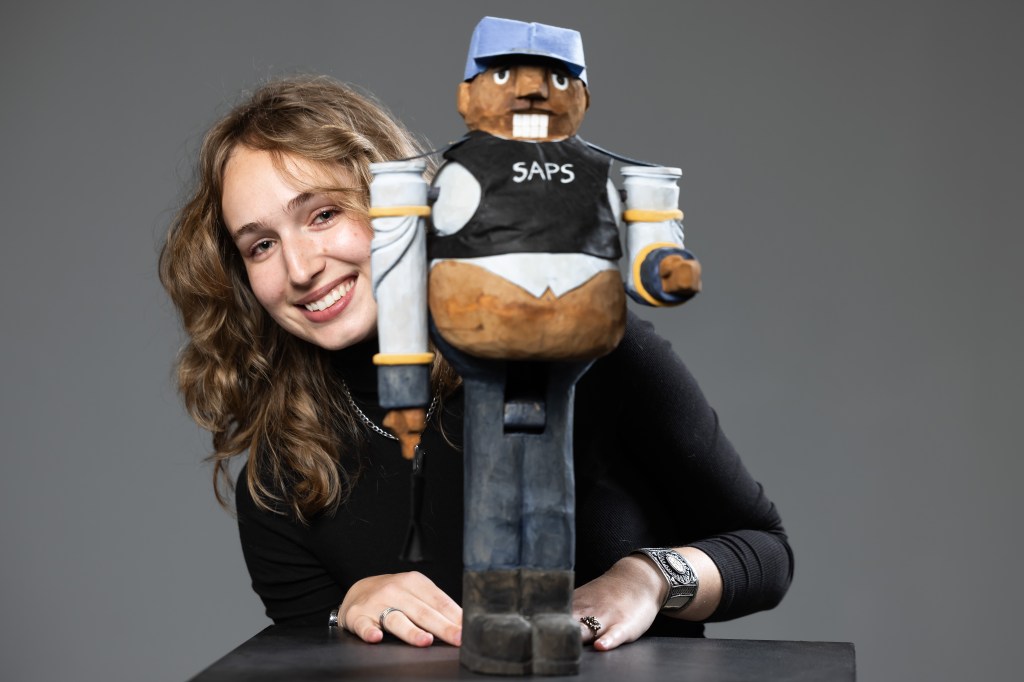
[Ball buster], Charlie de Bruto’s wood sculpture that saw her get the judges’ nod for a merit award for this year’s SASOL New Signatures Visual Arts Competition, takes a satirical stab at corruption in our country that has seeped so blatantly in our government with its highest pitch recently resounding in our police service, bathing the spotlight on highest ranking officials.
According to De Bruto, the artist who is right home with painitng potraiture and figures, the work took about two months to complete. Using the nutcraker as an inspiration Ball buster (2026) plays around with signs that satirically refers to a recent socio political matter, now ongoing in our courts, and open to the pubic which puts the vulnerability of the South African Police Service under scrutiny. Under the nature of the current regiment of the South African Police Service, are we safe? Slyly, in its humorous and witty way, this is the stalk question the work asks us to ponder.1– mmutleak.
ARTIST’S STATEMENT
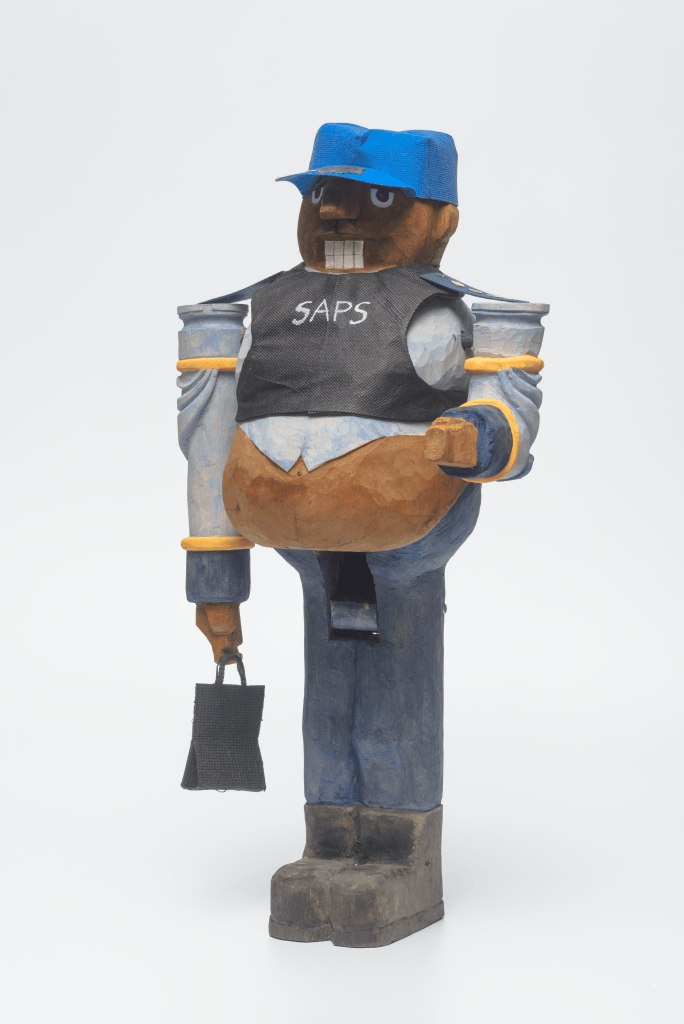
[Ball buster] began as a traditional wooden nutcracker soldier—a figure built to stand guard, protect, and break things on command. I kept the face, arms, and mechanism of the nutcracker but reshaped the rest to speak about power, opulence, and corruption through the lens of the recent Cat Matlala case.

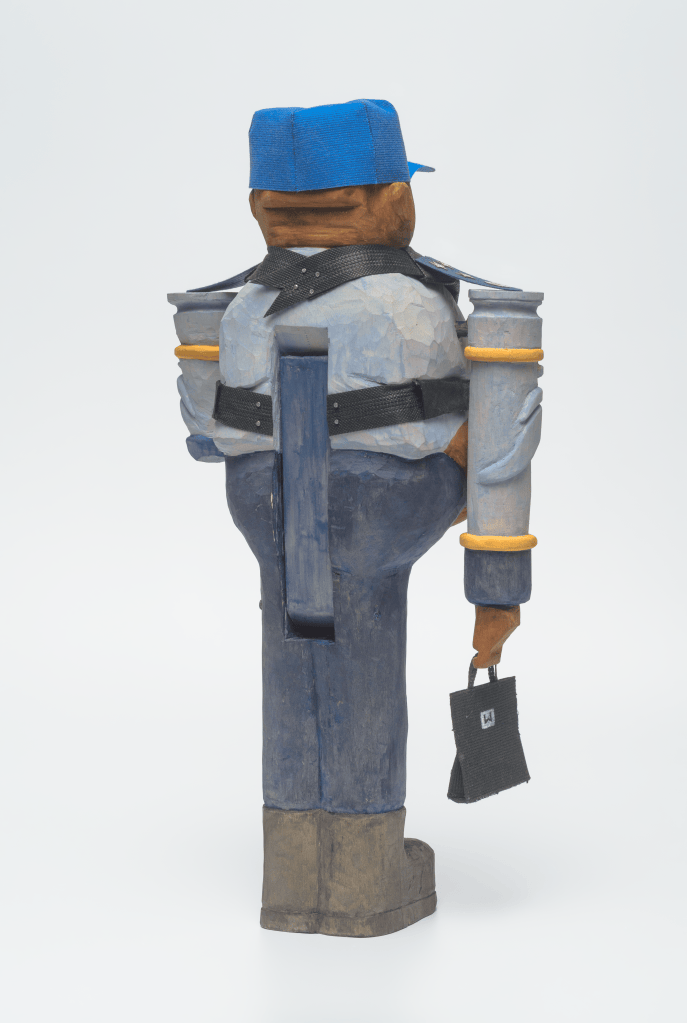
I carved the pattern from the official police hat into the arms and relocated the nutcracker mechanism to the genital area. This was a deliberate decision. The symbol of “cracking down” is moved to where the abuse of power sits: greed, control, and immunity to consequences. The uniform is central to the work. It is visibly too small for the policeman, with an exaggerated belly straining against the fabric and spilling out of the shirt. To me, it represents authority that has outgrown its purpose, both physically and morally.

The police badge and epaulettes were hand-cut and etched from brass. I designed a badge featuring a cat, directly referencing Vusimuzi “Cat” Matlala and Katiso “KT” Molefe. The epaulettes reference the senior officers arrested alongside them. The cat turns rank into rumour and honour into a meme, leaving visible traces of corruption.

The miniature Woolworths bag, hat, and vest were sewn from scratch and mostly by hand. The bag references the reports of Matlala carrying thousands of rands in an ordinary shopping bag. What stayed with me was not that it was hidden, but that it was visible. Like the oversized belly, it points to a system where corruption happens in plain sight.

The wood grain remains visible beneath the paint because corruption does not erase what is underneath; simply layers over it. The soldier can no longer march or protect. He can only consume, crack, and bust.
21 October
© Mmutle Arthur Kgokong, 2026
To reference this audio documentation, please cite:
Kgokong, M.A. 2026. Intraparadox, Interview with Charlie de Bruto. Woodie Woolie Craker. 09 Sep 2026. SNS25EditAmbient Mix. Mmutleak.com-Intraparadox.
Reference credits
List of figures
- Charlie de Bruto. Ball buster, 2026. Mixed media. 51 cm x 24,5 cm x 20 cm (2026).
- Charlie de Bruto. Ball buster, 2026. Mixed media. 51 cm x 24,5 cm x 20 cm (2026). [rear view]
Afterwords
* Original Image of Charlie de Bruto and artwork have been used with the courtesy of SASOL New Signatures Visual Arts Competition.
+Artist’s statement extract supplied by SASOL New Signatures Visual Arts Competition.
<> I remain grateful to Charlie de Bruto for agreeing to sit with me for this interview. Le ka moso.
[] As always, I am appreciative of SASOL Art Collection curator Cate Terblanche and Marina Carlow of Marina Smithers PR for coordinating the interviews with the artists for this year’s edition of SASOL New Signatures Visual Arts Competition.
Notes
- In its sly commentary on our South African Police Service, Ball buster recalls two sculptures in the Pretoria Art Museum’s permanent collection. One of these two sculptures is by Noria Mabasa (1938) and the other by Claudette Schreuders (1973). While Mabasa’s representation of the police man is in the old South African Police uniform, Schreuders ‘ iteration of the police man presents the police man in the democratic era, unarmed. Reminiscent of the naughties when the government tried to change the image of the police to a friendly one. These two works have always been shown side by side in the Albert Werth Hall’s Resistance art section of A Story of South African Art exhibition. Given the nature of the reflection on the police and their roles, with the specific reference to the period of conception of those two works, introducing De Bruto’s sculpture makes for a rich discussion with regard to the state of affairs of our police service today ↩︎


Tell us what you think