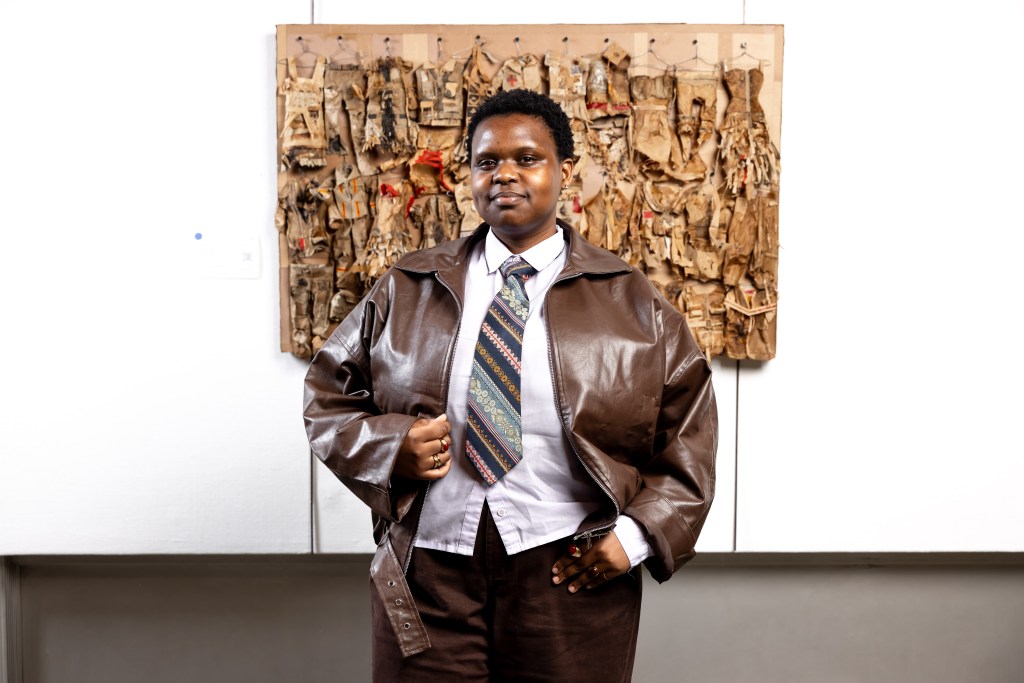
[In] this edition of Intraparadox, I sit with this year’s overall winner Sphumelele Zondi whose work The Laundry of a Nation (2026) got the nod during the final judging at the Pretoria Art Museum. The work shouldered through 122 entries to take the grand prize.
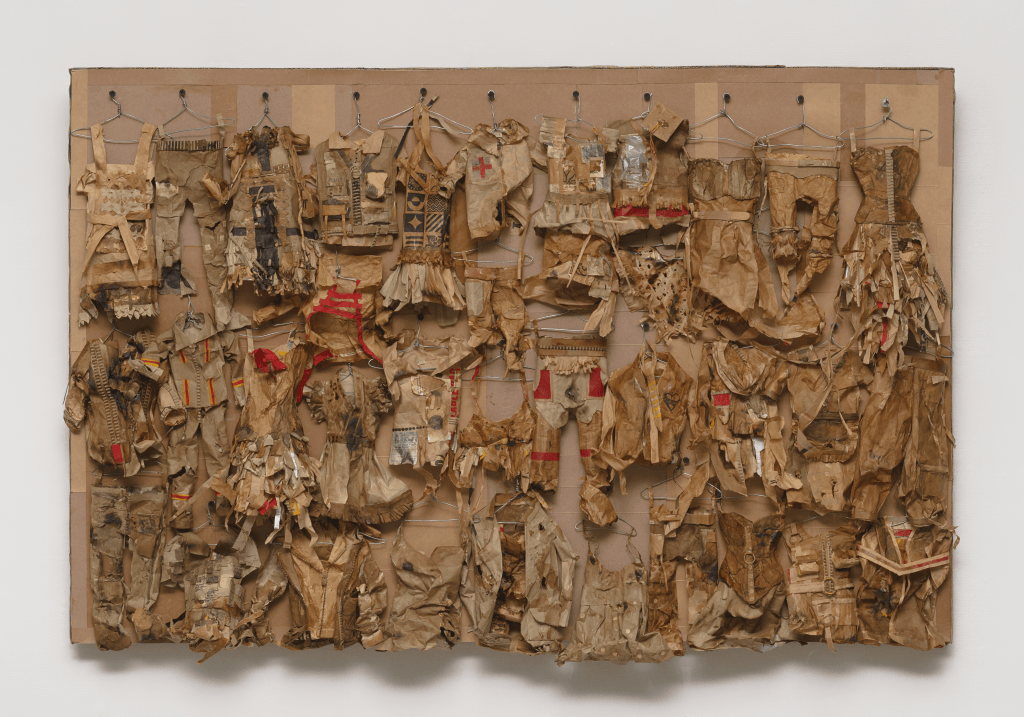
The Laundry of a Nation (2026) cleverly deploys the reuse of paper from fast food joints packaging to constructs garments on a minutia scale that simulates different personas in our society. As it emerges in the reading of the artist’s statement, Zondi was not merely reflecting on different characters pervading our society but also touching on intimate meaning of clothing as it passes through people. During our conversation I couldn’t help it but recall Nosiviwe Matikinca’s ceramic work that won the 2023 edition of the art competition titled Ndiziphiwe – They were given to me, where she too spoke about inherited garments albeit in a different context.
The Laundry of a Nation (2026) is a socially conscious work, meticulously made with attention to detail. The brown tint pervading the composition only surrenders to some reds here and there as the viewer visually interacts with the hung laundry pieces. A considerable amount of black and white lines and shades, in paper of course, are revealed latterly in the viewing. Thanks to the brownish tint the overall composition feels like a snapshot of our society frozen in time.

ARTIST’S STATEMENT
[This] work reflects on the emotional and social inheritance carried by young people within contemporary South Africa. Drawing from the visual language of clothing, labour, domesticity, and repetition, the installation considers how national histories continue to live within ordinary bodies and everyday materials.

In many South African homes, clothing exists beyond appearance. It carries labour, survival, class, memory, religion, and economic struggle. Garments move between siblings, neighbours, workers, schools, churches, and communities, slowly absorbing the emotional conditions of the environments they pass through. Within this context, clothing becomes both witness and archive.

The work also reflects on the culture of “Bazothini?”— the constant awareness of what others may say, think, judge, or expect. This social condition shapes identity, behaviour, silence, and self-perception from a young age. The pressure of communal observation often exists alongside absence: absent parents, absent opportunities, absent emotional support, and absent national promises.

This work speaks to collective emotional residue and asks how societies remember people and what kinds of emotional, social, and historical conditions are unconsciously passed down through generations.
11 October
© Mmutle Arthur Kgokong, 2026
To reference this audio documentation please cite:
Kgokong, M.A. 2026.Sphumelele Zondi. A Nation’s Laundry, (2026). SNS26EditOtwo-Mix. Mmutleak.com-Intraparadox.
Reference credits
List of figures
- Sphumelele Zondi. The laundry of a nation, (2026). Mixed media on cardboard paper. 75 x 116 cm
Afterwords
* Original Image of Sphumelele Zondi and artwork have been used with courtesy of SASOL New Signatures Visual Arts Competition.
+Artist’s statement extract supplied by SASOL New Signatures Visual Arts Competition.
<> I remain grateful to Sphumelele Zondi for agreeing to sit with me for this interview. Le ka moso.
[] As always, I am appreciative of SASOL Art Collection curator Cate Terblanche and Marina Carlow of Marina Smithers PR for coordinating the interviews with the artists for this year’s edition of SASOL New Signatures Visual Arts Competition.


Tell us what you think